Friday, August 21, 2020

The Solid Natural Foundation for Human Moral Equality

I believe I heard this from Professor Harry Jaffa, but it was a long time ago and I am going from memory alone.  If my memory is wrong, neither Professor Jaffa nor Mortimer Adler bear any responsibility.

Adler was teaching a class on classical texts during the Second World War.  As so many young men were missing from the home front, Adler’s class consisted entirely of women.  He was trying to illustrate the concept of human nature with this scenario.  “Suppose a creature entered the room.  He is eight feet tall, covered in hair, with fangs.  He sits down in one of these chairs and discusses the classical texts with us.  Would that be a man?”  After a brief pause for thought, one of the young ladies replied: “Well, Mr. Adler, times are hard.”

That joke, as I remember it, perfectly expresses the point I was making in my last post.  Adler’s imaginary monster may not belong to the biological species Homo sapiens, but he shows clear signs of being human in a moral sense.  He can read and communicate in auditory symbols, which suggests the uniquely human power (on this planet in this age) of logos. 

Is this a secure foundation for the doctrine of unalienable rights expressed in the Declaration of Independence?  I submit that it provides the most secure foundation possible: it works for anyone who can recognize the difference between plants, non-human animals, and human beings.

There is a very good reason why we recognize that animals and plants have a very different moral status.  We are concerned enough about animals that we punish people who abuse them.  We live in weird times but, so far as I know, no one has been arrested for abusing a carrot.  The reason is that the two kinds of organisms occupy very different levels on the existential pyramid.  Plants can flourish or wither, but they cannot suffer.  Animals can suffer and because we recognize that we do or should care about how we treat them.  This moral fact is a robust as the difference between a horse and a horse chestnut. 

The same order of distinction presents between human beings and animals.  Perhaps we shouldn’t exploit animals at all, let alone eat them, the way we do plants.  Some people believe that.  No reasonable person can say that we ought to give a dog the vote or allow her a space for liberty and the pursuit of happiness.  Dogs are, by nature, capable of no such things. 

The phrase “all men are created equal,” understanding “men” to mean all human beings, is grounded in such distinctions.  I can conceive of no better ground for human rights than in the nature of the creatures that we encounter in this world. 

Wednesday, July 29, 2020

Biological Species & Natural Kinds


If I have one big idea it is that one can understand Platonic and Aristotelian ontology and metaphysics better (or perhaps at all) by comparing them with modern evolutionary biology and vice versa.  I think I began to understand Aristotle much better, after decades of reading the Physics and the Metaphysics, when I realized that many contemporary debates in the philosophy of biology were recapitulating problems already present in Aristotle. 
Two days ago, I grabbed a book off my self on the way to the toilet.  Some of my biological processes seem to require reading material.  Darwinism and Philosophy [ed. Vittorio Hösle and Christian Illies (2005)] included an essay by Michael T. Ghiselin.  The latter is most famous for his answer to one of the great questions of modern biology: what is a species?  Is it a natural kind, like oxygen in the periodic table of elements?  Is it a group of (potentially) interbreeding organisms like elk?  Is it merely a customary grouping, like red pieces of laundry?  Each of these answers has its proponents. 
Ghiselin’s answer is that a species in an individual.  If that makes no obvious sense, you are in good company.  It made no sense to me until, sitting on porcelain and doing God’s work, I realized that Aristotle had joined the conversation.  By the time I finished the paperwork and returned to my desk, I was convinced that I understood Ghiselin’s argument and I was convinced that he was right. 
An individual is something that is located in space and time and, for that reason, has a history.  The Garmin fitness tracker on my left wrist is an individual; this one is mine, not somebody else’s.  The same is true of my wrist and me.  I had a beginning in time and my being traces a continuous path from that time and place to now.  The same is true of Homo neanderthalensis.  That species had a beginning, spread out across portions of the globe, and came to an end. 
Natural kinds are not located in time and space the same way.  Gold is gold wherever it occurs, whether it was dug up in California or discovered on Mars or produced in a supercollider.  As opposed to individual lumps of gold, gold has no history; it has only essential properties. 
Aristotle covered this same ground.  There are things that have properties-horses for example-and there are the properties that such things have-shape, weight, and species forms.  The things that have properties would seem to be the things that are real.  A horse can change color (age happens, even to Seabiscuit) and yet remain a horse; its color exists on in the horse and the color ceases to exist when the color has changed. 
This suggests one answer to the question: what is most genuinely real?  For the purposes of biology, at least, it is the individual organism.  From the horse one can abstract downward to its properties (color and size), its matter (meat and bone), and its parts (limbs and organs).  Likewise, one can abstract upwards to its species form, which links it to the other horses.  All of these are abstractions because they exist only in analysis; they depend for their reality on this here animal. 
Aristotle might have rested with this had he not inherited the central problem of Greek philosophy.  What is most real should be what is most knowable.  It is not clear that I can know anything about individual organisms.  Is she short or tall, young or old, alive or not.  On the other hand, I can know that horses are mammalian quadrupeds in a rather more secure way. 
Ghiselin’s view that species are individuals seems to address this problem.  If species are not eternal, they are not knowable in the same sense that triangles are knowable.  They are at least more knowable that a particular horse.  His account points, however, toward a solution to the problem. 
Ghiselin does not deny that the species as natural kind account points to something real.  The species horse is an emphatically real thing: there are lots of horses.  The natural kinds horse, mammal, etc., are real in so far as horses really are horses and mammals.  He just insists that natural kinds of this sort are properties of individual species. 
A good indication that we are on the right track is that our account to solve problems that once seemed too difficult.  I was raised, intellectually speaking, in a hotbed of natural rights theorists.  Under the guidance of Harry V. Jaffa, we took the Declaration of Independence very seriously.  In that I have not wavered. 
The Declaration speaks of the Laws of Nature and of Nature’s God.  Inferred from such laws is the self-evident truth that all men are created equal in so far as they enjoy certain unalienable rights.  Here I understand “men” to mean human beings.  My colleagues who reject evolutionary biology do so on the grounds that undermines confidence in the existence of a stable human nature that can bear such properties as unalienable rights. 
In the evolutionary scheme, species seem to differ not in kind but only in degree.  For example, lions and tigers can mate and produce ligers, hybrids that are not capable of having offspring.  This means that the two species share a large percentage of their DNA but not enough to produce a lineage.  So lions and tigers differ, genetically, only in degree.  Species as individuals emerged from common ancestors and so differ only in their unique history and genomic families.  From that point of view, the critics appear to be correct. 
Not so fast.  Individual species also present real differences in natural kind.  A particular lion may be so much a tiger, genetically speaking, and he may be bigger than more aggressive than another male lion when he squares off on the field of reproductive competition.  He is, however, no more a lion than any one of his competitors.  Socrates, Aristotle insists, is no more a man than any of his interlocutors. 
To bring this back to the Declaration, allow me to indulge in a little science fiction.  Suppose we encounter living organisms on another world.  Assume that these organisms emerged historically through the same evolutionary processes as life on earth.  We will find there no organisms that belong to the same species as those on our planet, at least in Ghiselin’s terms.  None of those species will have a common history with any of our species.  Yet the fact that we recognize them as living organisms means that they do share something vitally important.  The living organism is a natural kind.
Now suppose that we encounter Vulcans or something of that sort.  Green blood and distinct biological history notwithstanding, they are capable of symbolic communication and moral responsibility.  They can recognize mutual obligations between themselves and us newcomers.  They are capable of making contracts.  Are they “men” as the Declaration means that term?  Of course.
Human beings are certain kinds of beings.  Our species has its unique biological history, just as do individuals and populations of individuals within that larger individual that is our species.  While we are diverse in many respects, no son or daughter of humankind is more an organism, or a mammal, or a human being than any other.  I find the distinction between species as individuals and natural kinds to be worth thinking about.

Friday, June 26, 2020

Police Shootings & Racial Bias


The fundamental assumption underlying the protests and riots that followed the death of George Floyd is that racism in police departments across the US is responsible for the fact that a disproportionate number of Black males are shot by the police.  I say “death” and not “murder” not because I have any doubts about the facts because I suspect that the constant use of the latter term, especially by such persons as the Minneapolis chief of police, may make it harder for a court to do justice in this case. 
My purpose here is to question that assumption.  About twice as many White persons are shot and killed by police officers as Black persons, according to the Washington Post database.  That is obviously not a very useful statistic.  Non-Hispanic Whites make up about 76% of the US population; Blacks make up a little over 13%.  The WaPo helpfully explains that Black Americans “are killed by police at more than twice the rate of white Americans”.
A very good and recent summary of the statistics for fatal officer-involved shootings (FOIS) can be found in “Risk of being killed by police use of force in the United States by age, race–ethnicity, and sex.”  The authors do not address causation but confine their study to outcomes.  Here is a fascinating chart of FOIS restricted to males. 

The chart measures deaths by police per 100,000, controlling for population share, and tracks the numbers by age.  Unsurprisingly, the fatality rate rises dramatically at the teen years and drops steadily after 30 for all the age groups.  The most important fact is that the hump for Black males is much steeper than for any other defined group, and much lower than for White males. 
Does this chart point to a racial bias in FOIS nationally?  There is one anomaly that doesn’t support that explanation.  Asian Americans are proportionately less likely than Whites to be killed by police.  If the difference between the White and Black curves is evidence of racial bias against the latter, wouldn’t the low incidence for Asian Americans be evidence for a pro-Asian bias on the part of police forces across the country?  That hardly seems plausible. 
A more significant problem is that the racial bias explanation relies on a generally silent and implausible assumption: that, in the absence of racial bias, the FOIS stats for each demographic group would be perfectly proportional to its share of the total population.  That, in turn, assumes that all the demographic groups are exactly the same for all relevant characteristics.  That is also implausible. 
Another chart leads us in the right direction. 

This is about as robust a difference as one ever sees in social science.  Males are far more likely than females to be killed by police for all groups measured here.  This not, let me go out on a limb, gender bias on the part of the police.  It is a consequence of the fact that men are more likely than women to commit the violent crimes that might bring them into contact with the police and far more likely to escalate once they are exposed to the police.  Here is a bit from the Bureau of Justice Statistics (2011) tracking stats between 1980 and 2008. 
Males represented 77% of homicide victims and nearly 90% of off enders. Th e victimization rate for males (11.6 per 100,000) was 3 times higher than the rate for females (3.4 per 100,000). The offending rate for males (15.1 per 100,000) was almost 9 times higher than the rate for females (1.7 per 100,000).
Is there a connection for the Black/White differential FOIS rates and a difference in rates of violent crime?  Again from the BJS:
Blacks were disproportionately represented as both homicide victims and offenders. The victimization rate for blacks (27.8 per 100,000) was 6 times higher than the rate for whites (4.5 per 100,000). The offending rate for blacks (34.4 per 100,000) was almost 8 times higher than the rate for whites (4.5 per 100,000).
Two recent papers examine the relationship between police shootings and criminal activity among Blacks and Whites: here and here.  Here is a bit from one of them:
We first reproduce the well-known finding that Blacks are more likely to be fatally shot than Whites given population proportions… the odds were 2.5 times higher for Blacks to be killed by police compared to Whites given their population proportions.
However:
When fatal shooting data are benchmarked against the number of murder/nonnegligent manslaughter reports and arrests, the odds ratio obtained when benchmarking against population proportions flips completely. The odds were 2.7 times higher for Whites to be killed by police gunfire relative to Blacks given each group’s SRS homicide reports, 2.6 times higher for Whites given each group’s SRS homicide arrests, 2.9 times higher for Whites given each group’s NIBRS homicide reports, 3.9 times higher for Whites given each group’s NIBRS homicide arrests, and 2.5 times higher for Whites given each group’s CDC death by assault data.
In other words, given rates of homicide reports and arrests, across three databases, Whites were more likely to be shot by police than Blacks. 
The fundamental assumption underlying the current wave of civil unrest is false.  This might be an important fact.  One would hope that a responsible press would report it.  One should not expect that it will be mentioned by any major news outlet. 


Friday, May 29, 2020

Face Masks & Bad Science


Virginia Governor Ralph Northam has decided that all Virginians must wear face masks in “indoor public areas.”  An enlightened authority, he declares that he has good reason for his decision. 
“I am taking this step because science increasingly shows us that the virus spreads less easily when everyone is wearing face coverings,” Northam said during a press conference.
It’s nice to know that science shows this.  It would be helpful to know where we go to consult science.  Perhaps to one of science’s spokespersons, such as Dr. Anthony Fauci. 
"I want to protect myself and protect others, and also because I want to make it be a symbol for people to see that that's the kind of thing you should be doing," Fauci, the nation's top infectious disease expert and a member of the White House's coronavirus task force, told CNN's Jim Sciutto on "Newsroom."
Fauci said he believes that while wearing a mask is not "100% effective," it is a valuable safeguard and shows "respect for another person."
There are two very different argument in favor of face masks here.  One is that face masks serve as a symbol of virtuous intent.  It serves as a symbol for what people should be doing and it shows respect for other persons.  I confess that I am skeptical.  I happen to think that public health policy should be designed to advance public health and not to send signals. 
At any rate, it is surely not within the powers of the governor of Virginia to force people to wear cloth over their faces in order to show respect for others.  As Joe Biden might put it, there’s that thing… the thing in this case being the Free Speech clause of the First Amendment. 
The second argument is that a face mask is “a valuable safeguard,” even if not “100% effective”.  Okay.  Only an idiot would suppose that this practice is perfect.  But if not 100%, then what?  Does science tell us that face masks are 75% or 50% or 15% effective?  A little more precision would help in evaluating Governor Northam’s dictate. 
Dr. Fauci gives us none, but the British Guardian is more helpful.  Here we find a report from “a multidisciplinary group convened by the Royal Society called Delve – Data Evaluation and Learning for Viral Epidemics.”  This is what Delve has to say:
Our analysis suggests that [face mask] use could reduce onward transmission by asymptomatic and pre-symptomatic wearers if widely used in situations where physical distancing is not possible or predictable, contrasting to the standard use of masks for the protection of wearers,” the report notes. “If correctly used on this basis, face masks, including homemade cloth masks, can contribute to reducing viral transmission.
Someone should ask Governor Northam if when he says science, he means Delve.  It turns out that Delve isn’t exactly science.  The Guardian piece goes on:
The [Delve] report prompted other scientists to express their reservations, warning that it amounted to no more than opinion and overstated the available evidence.
Dr Simon Clarke, associate professor in cellular microbiology at the University of Reading, Dr Ben Killingley, consultant in acute medicine and infectious diseases at University College London hospital, and Dr Antonio Lazzarino of the Department of Epidemiology and Public Health at University College London all had the same view of the Delve Report.  To quote Dr. Killingley:
The report is overly optimistic about the value of face coverings and it is incorrect to conclude that the evidence shows that face covering can reduce viral transmission in the community,” he said. “There is in fact no good evidence that face coverings achieve this.”
Dr. Lazzarino goes further:
Based on what we now know about the dynamics of transmission and the pathophysiology of Covid-19, the negative effects of wearing masks outweigh the positive.
We might also consult the World Health Organization:
If you are healthy, you only need to wear a mask if you are taking care of a person with COVID-19.
Is that science? 
I am not competent to judge the science here, but Governor Northam’s dictate was a political act and there I have some expertise.  He knows no more about science than a hog knows about Sunday. 

Wednesday, May 6, 2020

A Foundational Library for Biopolitical Science


As an addendum to my last post, I can recommend three recent collections of scientific papers by a large number of scholars that will provide anyone with a solid foundation for reading and exploring biopolitical science. 
First and most important, The Princeton Guide to Evolution, ed. by Jonathan B. Lobos.  This is easily the best general guides to an academic subject that I have ever seen.  It is extraordinarily broad and at the same time thorough in each of its chapters.  It is generally accessible to non-specialists, though it may require some attentive reading. 
Second, Chimpanzees and Human Evolution, edited by Muller, Wrangham, and Pilbeam.  If you want to enjoy the benefits of the books I mentioned in my last post, just look up the author’s contributions to this one.  Both volumes were published as recently as 2017. 
Third, The Evolution of Primate Societies, edited by… everyone.  It’s the most dated of the volumes, being published as far back as 2012.  If you want to know what is natural in human social behavior, the best way is to consider our nearest relatives.  To read this book is to swim in that sea of questions. 
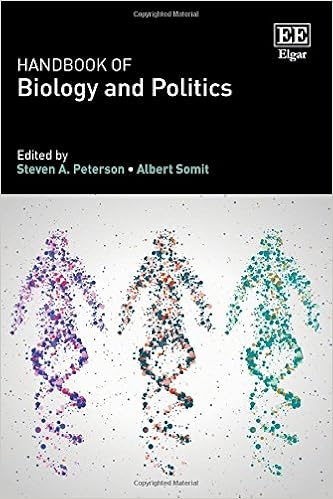
Finally, I would be remiss not to recommend one of the first general guides to biopolitical science: Handbook of Biology and Politics, ed. by Steven A. Peterson and Albert Sommit.  If biology and politics overlap anywhere in the realm of thought, this book will have a chapter on it.  I would also be remiss not to point out that the author of Chapter 13, “Political Ethics and Biology,” is very wise. 

Friday, May 1, 2020

A Biopolitical Science Library


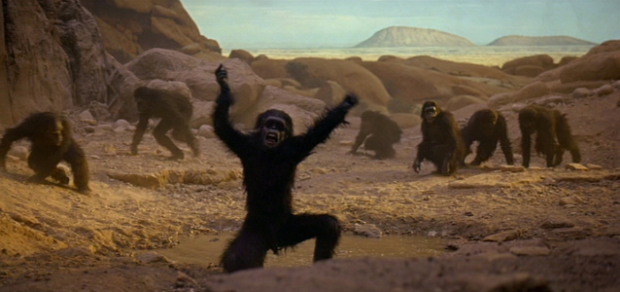
2001-a-space-odyssey-dawn-of-man-apes
I am returning to this blog after a hiatus of more than two years.  I am working on a book with the tentative title: Darwin and the Declaration of Independence.  My thesis is that contemporary research in the evolution of human social, political, and moral behaviors supports a natural right tradition that stretches from Aristotle and Plato, through Locke and the American founders, to Lincoln and Martin Luther King, Jr. 
In this post, I am going to list some of the books and papers in contemporary biosocial science that I lean on heavily.  They constitute a library in what I call biopolitical science. 
First and foremost, Christopher Boehm’s two magisterial works: Hierarchy in the Forest, and Moral Origins.  Boehm establishes that forager societies were characterized by what he calls an egalitarian ethos.  Every (male) member of the band in good standing (not a free rider or a bully) enjoyed the protection of the group and enjoyed more than less equally in whatever resources the group had at its disposal and got the group’s protection against any member who tried to push his weight around.  Group decision making was also egalitarian: each “citizen” gets his say and each abides by the consensus.  Boehm argues that the sanctioning of bullies and free riders (hungry but unwilling to contribute to the hunt) amounted to social selection.  Human moral emotions were shaped by selection pressure as individuals internalized the egalitarian ethos.  For a shorter introduction, see his paper “Egalitarian Behavior and Reverse Dominance Hierarchy”. 
Second, Michael Tomasello’s Why We Cooperate is a pretty good introduction his work on the innate human capacity for cooperation that distinguishes us from other social primates.  Tomasello’s work frames Boehm’s, showing how we got from individuals collaborating out of convenience to a species capable of generating the concept of “we” and “our” good.  For a shorter introduction, see his paper “Two Steps in the Evolution of Human Cooperation”. 
Third, Bernard Chapais’ Primeval Kinship, a forceful argument that it was pair-bonding, stable relationships between one male and two or more females, that transformed our early ancestors from typical social apes into a network of related individuals including aunts, uncles, and cousins.  Unlike our nearest relatives, the chimpanzees and bonobos, humans had a much better idea who their fathers were and that opened up the network of family relations.  When our ancestors began to recognize affinal relationships (in-laws) the network of familial relationships expanded indefinitely.  For a brief introduction, see “Monogamy, strongly bonded groups, and the evolution of human social structure”.   


Fourth, Richard Wrangham’s The Goodness Paradox.  Human beings are the best of animals and the worst of animals.  We get along within our groups and commit atrocious violence against other groups.  Wrangham answers the old question whether human beings are violent by nature or not with “yes.”  He does so by distinguishing between reactive violence (spontaneous irritation) and proactive violence (we could sneak up on them and…).  Most importantly, he invests in the domestication syndrome, the theory that selection against reactive violence produces a range of physical changes that present in human beings and other domestic animals.  We are the self-domesticated species.  See “Two types of aggression in human evolution”.  
These works, read together, provide a foundation for political science and political theory that has so far been sorely lacking in the discipline.

Friday, October 19, 2018

Socrates' biopolitical science


Plato’s Gorgias begins with a scene that could borrow the soundtrack from Westside Story.  Gorgias, a famous orator, has just demonstrated his talents before an audience at the house of a wealthy and powerful Athenian politician named Callicles.  The two are standing with a third trained orator, Polus, as people do after the show is over, when Socrates and his entourage approach.  You can easily imagine Socrates’ student Chaerephon and whoever else is with them‑Plato? Xenophon?‑snapping their fingers in rhythm with the swing of the orchestra.  The first word of the dialogue is Πολέμου, the Greek word for war.
Socrates engages in three dialogues, with Gorgias, Polus, and then Callicles.  A lot of the next two thousand years of the history of philosophy play out before your eyes.  I concentrate here on his conversation with Polus. 
Polus has been trained in the art of persuasion.  He believes that this art can empower him to convince anyone of anything.  That means that he can convince a jury of his or anyone else’s innocence regardless of the evidence.  He has a get out of jail free card. 
Why is such a power valuable?  To Polus, it is obvious: you can abuse, rob, or kill anyone you want to.  He thinks everyone would want such a power and is charmed by the thought that he, unlike almost everyone else, possesses it.  The power to kill without regard to justice is his treasure. 
Socrates destroys Polus with a simple disjunctive syllogism.  He asks Polus which is better: to do injustice without paying a penalty or to do injustice and suffer the penalty?  Polus insist that the first is obviously better than the second.  So far, so good.  Then Socrates asks which is more disgusting?  Polus admits the obvious.  To do injustice and get away with it is disgusting. 
It seems that Polus could hardly deny it.  His name is pronounced almost the same as polis, the Greek word for the political community.  How do we, the people of this polis‑Athens, the United States of America‑see it when we think that someone has done a terrible thing and gotten away with it?  We are disgusted. 
The Greek word for disgusting is αἴσχιον.  It indicates both moral and physical ugliness.  It is frequently translated as “shameful” or “foul.”  Socrates points out that if something is αἴσχιον it is either unpleasant or bad for you or both. 
I offer my own illustrations.  Spoiled meat is unpleasant and bad for you.  Reattaching a severed finger by the application of leaches is disgusting enough, but good for you if it works.  Shooting heroin is the very opposite of unpleasant; it is, however, disgusting because it is very bad for you. 
Since killing with impunity is not unpleasant to the murderer at least, it must be bad for you.  You shouldn’t do it, if you know what you are doing. 
Here is the disjunctive syllogism.  If killing without penalty is disgusting, then either it is unpleasant or it is bad for you.  It isn’t unpleasant to kill without penalty (it’s exquisite! Polus insists).  Therefore; it is bad for you. 
1.       (D É (U Ú B))
2.      D
3.      (U Ú B)
4.      ~U
5.      \ B
If you don’t follow the symbolic logic, take my word for it.  This is a logically valid proof.  If the premises are true, the conclusion is inescapable.
At this point I can introduce a little biosocial science.  The same part of the brain that is engaged when we sense something physically disgusting‑running sores or spoiled meat‑is engaged when we view something morally disgusting‑someone abusing a child or cheating a friend.  If the one clearly functions to help us avoid what is bad for us, it is likely that the latter functions the same way. 
Today I read a study by Tom R. Kupfer and Roger Giner-Sorolla: Communicating Moral Motives: The Social Signaling Function of Disgust, from the journal Social Psychology and Personality Science.  The results of the study indicate that when someone expresses disgust in reaction to some moral violation such as cheating a friend, she is signaling to others that she cares about moral principles and is prepared to join others in enforcing them.  That is good for her because it attracts other similar partners.  It is good for us, because it makes it possible for us to trust one another and so cooperate more effectively.
At some point in our evolutionary history, our biological capacity for disgust was harnessed by our evolved psychological mechanisms for cooperation.  Doing injustice without paying a price may be good for the individual in the short run but it is bad for the political community and therefore bad for its members in the long run. 
Socrates didn’t know about evolution.  He understood the truth about justice and injustice perfectly.  Only now is modern science catching up to him. 

Friday, August 24, 2018

Political Science


I have been reading a very interesting article tonight, in the Atlantic: The Nastiest Feud in Science.  It is a feud that I have been interested in for decades.  The issue concerns what killed off the dinosaurs, and it has divided scientists concerned with this question into two hostile factions. 
The majority faction holds that the dinosaurs went extinct due to a sudden event: an asteroid, “larger than Mount Everest is tall, slammed into our planet with the force of 10 billion atomic bombs.”  This is the “bad weekend” thesis.  By Monday, the dinosaurs were history. 
The minority faction holds that the major extinction event that included the dinosaurs but also almost all the rest of the creatures on earth was a much more gradual process.  The culprit here was a series of eruptions in East Central India, the Deccan Traps, that went on for 350,000 years. 
Both sides have strong evidence to bring to the table.  Deposits of iridium are found all over the world that seem to have been deposited at the same time as the mass extinction and that must have come from the asteroid collision.  On the other hand, “at the same time” is ambiguous in geological terms.  The big boom may have come 200,000 years before the mass extinction.  That’s a long weekend. 
What is clear is that the two sides do not merely disagree.  They despise one another and have long been at war with one another.  They accuse each other of any number of scientific sins in the most bitter of terms.  The asteroidsheviks have gone to great lengths to torpedo the careers of any scholar who dares challenge their thesis. 
I am a student of Plato and so I know very well that philosophical and scientific quarrels almost always become political quarrels.  Socrates relentlessly embarrassed the sophists and orators of ancient Athens and they responded by using the machinery of the Athenian court to kill him.  This conflict became political in a more direct sense because Socrates’ enemies included politically powerful men.  See The Enemies of Socrates. 
The quarrel between the worshipers of asteroid and those of the volcanoes is much the same.  A key to the larger political question implicated by this quarrel about ancient geological history lies in this passage in Bianca Bosker’s Atlantic piece. 
Understanding the cause of the mass extinction is not an esoteric academic endeavor. Dinosaurs are what paleontologists call “charismatic megafauna”: sexy, sympathetic beasts whose obliteration transfixes pretty much anyone with a pulse. The nature of their downfall, after 135 million years of good living, might offer clues for how we can prevent, or at least delay, our own end.
When someone who is not an idiot writes a passage like that, you can be sure that there is something else going on.  Let’s consider: if the one side is right, all we have to do is figure out how to shoot down asteroids.  If the other side is right, all we have to do is figure out how to plug volcanoes.  Allow me to humbly suggest that neither can “offer clues for how we can prevent, or at least delay, our own end.” 
I suspect, though, that the tide may soon turn in favor of the volcano side.  Greenhouse gasses produced by human industry look a lot more like volcanoes than like asteroids.  Of course, this is only a metaphor.  Comparing the human activity over the last century to a range of volcanoes pumping out clouds of gases for hundreds of thousands of years is like comparing a Florida sink hole to the Grand Canyon.  The volcano thesis tells us nothing useful about the climate change question.  In politics, however, that is not what matters.  What matters is the emotional impact. 
I am a climate lukewarmer.  I don’t doubt that the world warmed significantly over the last century and I think the evidence supports the claim that human activity had something to do with this.  I am not at all certain that this bodes ill for human beings and most other creatures.  I am certain that we are not going to do anything significant in the short run to control global emissions.  I am very certain that the dinosaurs aren’t going to teach us what to do. 
The Bosker piece is, I suspect, largely intended to support the alarmist agenda on climate change.  Read reasonably, it does the opposite.  The same politics that infects the dinosaur controversy infects the climate change controversies.  Anyone who doubts the alarmist agenda is vilified.  Bosker’s piece suggests that we should be suspicious of everyone on both sides of such questions. 
Science is the best guide we have to the nature of the world.  Scientists, however, are just as human as anyone else.  Man, as Aristotle boldly claimed, is the political animal. 

Friday, July 6, 2018

Darwin vs. the Progressives


I may be one of the only scholars to escape Claremont without being or becoming obsessed with the Progressives.  As a result, I have never paid much attention to John Dewey or Woodrow Wilson or the rest of that lot.  The general idea, if I get it, is that the Progressives wanted to empower the people and get rid of silly constitutional limitations on the popular will‑guided, of course, by experts in the sciences of politics and economics. 
I have just finished reading a paper about the use of “Darwinism” by the Progressives.  I can’t site the paper, because it is a draft of what will be presented at the panel I am chairing at the meeting of the International Political Science Association in Brisbane, Australia.  By the way, that’s Brisbin to those in the know.  It is a wonderful introduction to Progressive thought, so now I know more than I really want to know. 
This is my summary of the paper, for which the unnamed author bears no responsibility.  The Progressives believed that modern science could produce much more efficient societies, free from the old evils of factionalism, greed, etc., if only it could get complete command of the powers of government.  Standing in the way of that complete command were the constitutional devices—separation of powers, checks and balances, federalism, etc. 
To fully empower government to do what the Progressives thought it could do, they had to get rid of those obstacles.  To do that, they had to discredit the philosophical principles on which the constitutional order was based.  The Founders believed that they understood human nature.  The believe that human tendencies toward corruption and self-destruction could not be eradicated, they could only be ameliorated.  That is what limited government was designed to achieve. 
The Progressives attempted to undermine the Founding principles by attacking the idea of a fixed human nature.  The Founder’s work made sense by the light of late 18th century science, they argued, but science has moved on.  We now know that human nature changes just like everything else does.  We can mold ourselves into new and better beings, free from the moral infirmities of our predecessors, if only be can break free of the shackles they put in place. 
This is where Darwin comes in.  At the very least, Darwinian evolution allowed the Progressives to argue that human nature was not something fixed; therefore, a political doctrine based on the idea of natural rights was untenable.  However, Darwin didn’t give the Progressives what they really needed.  They needed the idea that history had a direction from the primitive and bad toward the advanced and good.  They got that, more or less consciously, from Hegel and Marx.  Without the latter, the idea of a changing human nature provides no comforts, let alone a promise of liberation. 
If I get all this right, Darwinism was little more than a gloss—if a very useful gloss—on Progressive doctrine.  It allowed them to dismiss the idea of human nature without much serious thought.  They didn’t have to understand it; they just needed to employ it as a slogan. 
To put it charitably, the Progressives’ view of Darwin was a little more sophisticated than Adolph Hitler’s understanding of genetics.  In Mein Kampf, which I haven’t read and neither have you, Hitler apparently argued that if someone from a superior race mates with someone of an inferior race, you get children who are mediocre.  The problem, of course, is that genetics doesn’t work that way at all.  Breeding a tall animal with a short one might get you middle sized offspring, but it also might give you some tall offspring and some short ones.  Genetics is digital rather than analogical. 
The problem with the Progressives’ view of Darwinian theory is threefold.  The most important problem is that evolution by natural selection is not fundamentally progressive.  It shapes organisms for their respective ecological niches, but that can mean simpler, dumber creatures as often as more complex and smarter creatures. 
It is true that there is a progressive dimension in the history of evolution.  All organisms are autonomous in the sense that they resist the influence of environmental forces.  That is what it means to be alive.  The increases in organic complexity over time map onto increases in autonomy: warm blooded animals segregate their organs from one another and maintain their body temperature in order to (adaptationist language here) be more independent from the local environment. 
The second problem with the Progressive view of Darwinism is that it completely ignores the relevant time frames.  Yes, the human species has changed over time; however, it matters how much change and how much time we are talking about.  According to most current accounts, human beings have been pretty much the same animals for at least fifty-thousand years.  Have we changed enough since Romulus and Remus, let alone Jefferson and Madison, to make a practical difference for political theory?  No.  If the Founder’s theory was good enough for human beings two hundred and forty-two years ago, no contemporary evolutionary theory will undermine it. 
The final and most important problem is that species do not change in all parts of their organic structure at the same rates and some parts of them do not change much at all.  While the simplistic model of the triune brain—reptilian, mammalian, and neomammalian—may be discarded, the basic idea is sound: evolution doesn’t work transforming existing organisms into brand new ones, but by reorganizing what it has already got and keeping what works.  
Human beings may be more than animals (I think we are) but we are at least animals.  Almost all of what our ancestor was before she split into Pan and Homo lines is still in both of us.  Most of the earliest mammal is still in our neocortex.  The reptile was not purged; he was reassigned. 
Human beings are such interesting and promising creatures precisely because we carry within us the history of our organic predecessors, back to the Ur organism and yet have achieved a human world.  The organic burdens are part and parcel of the organic promise.  We still come into this world, eat and defecate, and go out of it the same way our dogs do. 
The political principles of the Founding recognized both sides of the coin.  We are capable of living beautiful lives; yet to do this, we have to manage our animal nature.  The Founders were wise and mature in their thought.  The Progressives were naïve and simple minded. 


Wednesday, June 20, 2018

Species Ancient & Modern


I seemed to have misplaced my copy of Natural Right and History, one of the three books that most shaped the beginning of my career as a scholar.  In case you are wondering, the other two were Aristotle’s Politics and Harry Jaffa’s Crisis of the House Divided.  I encountered all three in a course I took with Jeff Wallin at Arkansas State University, many moons ago.  At any rate, I am going from memory here and, dare I say, deploying my own examples.  No one should blame Strauss, Wallin, Jaffa, or Aristotle for my reflections. 
According to Leo Strauss, philosophy begins with the discovery of nature.  Prior to that discovery, human beings were well aware that different things had different ways.  Menstruation was the way of women and peeing on posts was the way of dogs, just as a life of military training was the way of Spartans and a life of wine was the way of Athenians. 
Nature was discovered when someone in ancient Asia Minor realized that there was a difference between the fact that some people burn their dead and some people don’t and the fact that fire always goes up whether you are among the one people or the other.  The ways of peoples are partly determined by convention.  We do it this way because we agree that this is the way it should be done.  Other peoples do it differently. 
On the other hand, no one dishes up grains of sand or puts their latrines in their kitchens.  These ways are determined not by convention but by nature.  The philosophers tried to understand nature‑the things that did not change from one political community to another and that were, apparently, the same everywhere and always.  When philosophy turned to examine politics, with Socrates, the task was to determine how the various regimes emerged from one common human nature. 
Strauss came back to me yesterday when I encountered the following passage from the great philosopher of biology: Ernst Mayr.  The passage is addressed to a certain position in the philosophy of biology concerning the concept of the species.  Darwin himself seemed to accept this position in his Origin of the Species.  It is called nominalism, the view that species concepts like horse or housefly are entirely conventional, arbitrary groupings that we make up as we go.  Mayr would have none of that.  From Towards a New Philosophy of Biology:
I have always thought that there is no more devastating refutation of the nominalistic claims than the fact that primitive natives in New Guinea, with a Stone Age culture, recognize as species exactly the same entities of nature as western taxonomists.  If species were something purely arbitrary, it would be totally improbable for representatives of two drastically different cultures to arrive at the identical species delimitations.  Although a few nominalists still survive, it is now almost unanimously agreed that there are real discontinuities in nature, delimiting different species.
It’s pretty obvious to common sense that a house cat and a housefly belong to different species; but what about a dog and a wolf?  Some of the former look very much like the latter and they can breed together.  What about a horse and a donkey?  They can have a mule as a child but cannot have grandchildren.  Things get much messier when you look at plants, let alone microorganisms.  Is it possible that our species concepts are merely convenient? 
Mayr offers us a reason to reject that idea.  If a stone age culture marks out the same species distinctions as modern western taxonomists, then those distinction are probably not cultural artifacts. 
What strikes me about Mayr’s proof is that it makes precisely the distinction that Strauss points out.  Species are ontologically real because they do not change from one set of conventions to another.  The various species that we all recognize are not conventional categories but natural categories. 
I have been writing a paper for the meeting of the International Political Science Association in Brisbane, Australia, next month.  My topic is Darwin and the Declaration of Independence.  One common criticism of Darwinian biology is that it is incompatible with the Declaration’s account of natural rights.  The latter states that “all men are created equal.”  The critics claim that Darwinian biology destroys the concept of species as natural kinds and so precludes the argument in the Declaration.  How can all me be created equal if there aren’t really any human beings, if the human species is a mere convenience, imposed on a smear of organisms differing from on another only in degree? 
I think I have shown, in the current draft of my paper, that Darwinian biology allows for species distinctions that are more than robust enough for the purposes of the Declaration.  What Mayr’s proof shows is that the species concept in modern biology can be defended on grounds that go back to the very origins of philosophy in ancient Greece.  I am content with that.