Showing posts with label evolution. Show all posts

Friday, May 1, 2020

A Biopolitical Science Library


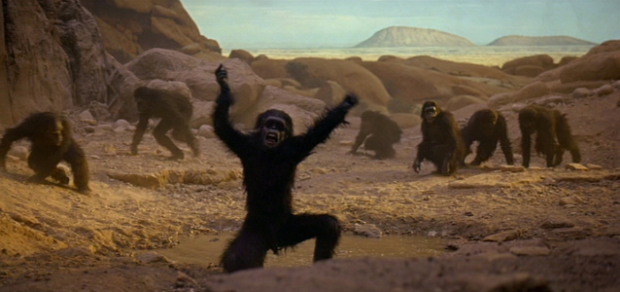
2001-a-space-odyssey-dawn-of-man-apes
I am returning to this blog after a hiatus of more than two years.  I am working on a book with the tentative title: Darwin and the Declaration of Independence.  My thesis is that contemporary research in the evolution of human social, political, and moral behaviors supports a natural right tradition that stretches from Aristotle and Plato, through Locke and the American founders, to Lincoln and Martin Luther King, Jr. 
In this post, I am going to list some of the books and papers in contemporary biosocial science that I lean on heavily.  They constitute a library in what I call biopolitical science. 
First and foremost, Christopher Boehm’s two magisterial works: Hierarchy in the Forest, and Moral Origins.  Boehm establishes that forager societies were characterized by what he calls an egalitarian ethos.  Every (male) member of the band in good standing (not a free rider or a bully) enjoyed the protection of the group and enjoyed more than less equally in whatever resources the group had at its disposal and got the group’s protection against any member who tried to push his weight around.  Group decision making was also egalitarian: each “citizen” gets his say and each abides by the consensus.  Boehm argues that the sanctioning of bullies and free riders (hungry but unwilling to contribute to the hunt) amounted to social selection.  Human moral emotions were shaped by selection pressure as individuals internalized the egalitarian ethos.  For a shorter introduction, see his paper “Egalitarian Behavior and Reverse Dominance Hierarchy”. 
Second, Michael Tomasello’s Why We Cooperate is a pretty good introduction his work on the innate human capacity for cooperation that distinguishes us from other social primates.  Tomasello’s work frames Boehm’s, showing how we got from individuals collaborating out of convenience to a species capable of generating the concept of “we” and “our” good.  For a shorter introduction, see his paper “Two Steps in the Evolution of Human Cooperation”. 
Third, Bernard Chapais’ Primeval Kinship, a forceful argument that it was pair-bonding, stable relationships between one male and two or more females, that transformed our early ancestors from typical social apes into a network of related individuals including aunts, uncles, and cousins.  Unlike our nearest relatives, the chimpanzees and bonobos, humans had a much better idea who their fathers were and that opened up the network of family relations.  When our ancestors began to recognize affinal relationships (in-laws) the network of familial relationships expanded indefinitely.  For a brief introduction, see “Monogamy, strongly bonded groups, and the evolution of human social structure”.   


Fourth, Richard Wrangham’s The Goodness Paradox.  Human beings are the best of animals and the worst of animals.  We get along within our groups and commit atrocious violence against other groups.  Wrangham answers the old question whether human beings are violent by nature or not with “yes.”  He does so by distinguishing between reactive violence (spontaneous irritation) and proactive violence (we could sneak up on them and…).  Most importantly, he invests in the domestication syndrome, the theory that selection against reactive violence produces a range of physical changes that present in human beings and other domestic animals.  We are the self-domesticated species.  See “Two types of aggression in human evolution”.  
These works, read together, provide a foundation for political science and political theory that has so far been sorely lacking in the discipline.

Friday, October 28, 2016

Good News about Evolution and Classical Political Philosophy

I was a student of the late Harry V. Jaffa.  One of the seminal moments in my intellectual career took place over two days, when I read Jaffa’s Crisis of the House Divided.  Anyone who has read that amazing book will sympathize with my experience.  When I went to bed on the first night, I was convinced that Stephen Douglas was right in his argument with Lincoln.  When I finished the second half of the book the next day, I was persuaded that Lincoln was right: slavery is by nature always and everywhere unjust.  I have never revised that opinion, and I have been a natural right thinker ever since. 
Another seminal moment came many years later when I was reading a primer on evolutionary psychology.  It had occurred to me that, if we want to talk about natural right, we might want to know something about nature.  Sitting on my deck one grey afternoon, I realized that Darwinian evolution was not opposed to Aristotle and to the classical natural right that Jaffa championed.  On the contrary, evolutionary theory can provide powerful support for the thought of Aristotle.  I later concluded that the same was true for Plato. 
Most of those who take the writings of the classical philosophers seriously, not as mere historical artifacts but as guides to the truth about morality and politics, see evolutionary thought as utterly opposed to classical thought.  A good example of this is the first two paragraphs of a 2013 conference paper written by Steven Forde. 
As a political theorist by training, I avoided tackling the problem of Darwin for many years. I suspected that the theory of evolution would call into question the very enterprise of political theory, as traditionally understood. My fears have largely been borne out, as the following indicates. Yet it is impossible in this day and age to deny that evolution is the truth—that human beings, like all existing life forms, evolved out of prior, typically simpler life forms. Our organs, including our brains, are all descendants of organs found in earlier primates. Certain key intellectual capacities, such as the capacity for language, are “hard wired” into our neural makeup. Certain emotional responses appear to be so as well, including some closely tied to our sense of morality. These include such natural responses as empathy and indignation, emotions that have analogues in other primates today, and presumably in our evolutionary ancestors.
These facts, along with findings of neuropsychology concerning gratification received from cooperative and other putatively moral behavior, suggests that morality is hard wired into us. This is good news and bad news. The good news is that it seems we are destined to remain a moral, cooperative species regardless of intellectual or cultural trends. The bad news is that this morality has no grounding of the sort that ordinary human beings believe it does, and that traditional political philosophy sought. It is simply an artifact of our evolutionary heritage. This is the conclusion I dreaded all the years I avoided this topic of study.
This is an example of what I would call a pious dread.  It reminds one of the famous quote from the wife of the Bishop of Worcester who, when informed of Darwin’s theory, supposedly said:
My dear, descended from the apes! Let us hope it is not true, but if it is, let us pray that it will not become generally known.
The most significant passage in that quote is this one:
Morality has no grounding of the sort that ordinary human beings believe it does, and that traditional political philosophy sought. It is simply an artifact of our evolutionary heritage.
My question, which I do not think was addressed in Forde’s piece, is what kind of grounding do ordinary human beings think morality has?  What kind of grounding does traditional political philosophy seek?  Human beings, ordinary or otherwise, are moral animals.  We are endowed with moral emotions, including guilt, righteous indignation, and admiration.  Perhaps what we seek is an account of moral right that satisfies those emotions.  What sort of account might that be?
The most satisfying account is this: justice is what God demands and human beings must choose, or else.  Divine law provides powerful support for moral emotions; however, as such, it doesn’t provide much that the philosophically inclined can work with.  What does provide that material is the fact that a lot of moral rules seem to be socially functional.  Prohibitions against murder, theft, adultery, and incest, are all defensible by rational argument. 
The strongest defense of justice without direct appeal to divine law is found in Plato’s Republic.  In the first book Thrasymachus argues that justice is no more than a confidence game played by the strong in any political community in order to persuade the weak to accept their lot.  The weakness in that argument is that it can’t explain why the con job works.  If all of us want the same things, power, prosperity, revenge, why are moral admonitions useful to the strong? 
Socrates argues that even a gang of thieves must observe some rules of justice among themselves if they are to effectively exploit others.  In the second book, Glaucon and Adiemantus challenge that answer.  Glaucon presents a view of justice that he himself finds repulsive.  Most people would like to exploit everyone else but know that they are not powerful enough to do so.  Principles of justice are then a mere compromise: we agree not to exploit others so that others will not exploit us.  Adiemantus argues that people do genuinely value justice, but what they care about is not the thing itself but the reputation for it.  A man who appears just will attract good friends and arrange good marriages for his offspring. 
Why are the two brothers unsatisfied with their respective accounts of justice?  While these accounts provide objective grounds from justice, they are vulgar rather than noble or, what is the same thing, beautiful.  Apparently, only a beautiful account of justice will be genuinely satisfying. 
In the body of the Republic, Socrates presents an account of justice as an element in a well ordered soul.  In such a soul, intelligence rules the passions and the passions rule the appetites.  An ideal regime would reflect that order, with the philosopher (Socrates or someone like him) ruling, the exquisitely trained military class obeying his commands, and the producer class minding its own business by producing. 
This account provides a beautiful and coherent solution to the problem.  If an individual behaves unjustly, he feeds the worst part of himself and that means that he cannot have the kind of soul that makes for the best possible life.  The same is true of political communities.  Thucydides supplements this account.  Cities that behave unjustly toward other cities encouraged injustice among their own citizens, thus undermining the cooperation upon which their strength depends.  What is most beautiful is the human being who lives the most admirable life and the city that governs itself and its foreign policy in a way that makes for the most admirable civil life.  If justice contributes to that, then justice is indeed beautiful. 
Socrates takes the moral emotions of his interlocutors for granted.  He does not try to explain how we became such creatures for whom a beautifully ordered soul and a beautifully ordered regime might be possible.  He does suggest that the most natural political community is one that provides for the minimal physical needs of human animals with the least effort.  For justice to be genuinely beautiful, it has to provide for a life that includes more than that: noble deeds and, last but not least, the leisure for some to pursue philosophy. 
Evolutionary theory explains how we became the kind of animal that Socrates examines.  Our moral emotions were shaped by eons of natural selection.  They made it possible for us to cooperate on a level far beyond that of other animals.  At some point, they made it possible for us to satisfy our basic biological needs and then seek satisfactions beyond those needs.  The rise of civilization made it possible for some people (and eventually most people) to stop worrying about the next meal and look instead for something interesting to do. 
The best human lives are ones that are not merely physically and emotionally satisfying.  They are interesting.  What interests us is rooted in our evolutionary heritage but necessarily goes beyond that heritage.  We inherit preferences for color, symmetrical lines and objects, and landscapes including mountains and water.  That doesn’t mean we have genes for liking a J. M. W. Turner painting.  An appreciation for great art depends on evolved dispositions; however, it explores new existential space that cannot be reduced to those dispositions.  We inherit preferences for fat, sugar, texture, and color in foods.  That doesn’t mean that we have genes for liking a four star Michelin meal.  We inherit preferences for certain kinds of sounds and harmonies.  A William Parker jazz composition builds on those evolved dispositions to produce something that will not advance the interests of my genes but is simply beautiful. 
A house is an artificial product.  Houses do not grow as trees do.  It is nonetheless natural in so far as it satisfies natural inclinations for a safe, warm, and dry shelter.  Political communities are artificial.  As Aristotle recognized, we have to build them more or less deliberately.  They come to be, he said, for the sake of mere life.  That is Darwinian thinking.  Political communities emerged in a long history of human beings trying to survive in as comfortable a way as possible.  They exist, Aristotle said, for the sake of the good life.  Once a political community has achieved self-sufficiency, its citizens can turn to explore the benefits of existential freedom. 

This is the ground for morality that Forbes craves.  Cooperation based on reciprocity is central to every code of moral behavior.  It not only allows individual human beings to form communities that secure the most basic needs; it also allows for the production of surpluses that allow us to live beautiful lives.  His pious fear is unfounded.  
Sunday, August 14, 2016

The Chauvinism of Michael Le Page

Since the late 1990’s, I have been teaching a course called Human Nature and Human Values.  Every year I get exactly one very bitter complaint on my student evaluations.  I don’t know why it is so consistently just one.  This year was no exception; however, in this case the student was unusually honest and articulate.  She or he complained about the material.  I am paraphrasing here. 
The professor talked about human beings and animals raping and abusing and killing one another; about women’s reproductive value and men being horny and greedy.  I was uncomfortable with this. 
I can only plead that I was doing my job.  College is about becoming a grownup.  To do that, you have to have some awareness of how the world really works and have some idea what the people who shape the human world (including, especially, scientists) are thinking.  This sometimes means finding out things that you don’t want to know.  I warn students at the beginning of every class: if you don’t want to know that your parents had sex, you might have a problem with this material. 
I am genuinely sympathetic to the author of the above comment, in large part because of the honesty and self-knowledge evident in it.  Usually the one bitter complaint focuses on something other than the real issue: the tests were unfair, he misspelled words on the board, oh, and he talked about lesbian monkeys.  This student laid the real problem on the table: he or she did not like to watch a film clip of a male lion killing the cubs of his predecessor. 
One of the first times I taught the course and young woman visited my office after the final and confessed that, every day after she left the classroom she would go to her car and cry.  She thought I was telling her that, because there are evolutionary explanations for maternal love, that her mother didn’t really love her.  I belatedly corrected that error (see the previous post) and have been mindful about it ever since. 
On the other hand, the class is very popular and I always get a lot of favorable comments.  This is so despite the fact that most of my students come from traditional religious backgrounds.  I explain that what they believe is none of my business.  I make it clear that I respect them even if they disagree with me on really important things. 
I also try to show them that even if they cannot accept certain fundamental parts of evolutionary theory, for example the common ancestry of human beings and chimpanzees, they can still recognize how natural selection works on a daily basis and appreciate how our similarity with chimpanzees can help us understand ourselves.  My favorite teach phrase is this: human beings may be more than mere animals, but we are at least animals.  That’s all they want. 
One of the great obstacles to this kind of approach is the chauvinism of many Darwinian apostles.  Recently I have been reading a collection of articles from the New Scientist magazine.  Life on Earth: Origins, Evolution, Extinction is great reading.  Michael Le Page leads off the chapter on evolution with a list of misconceptions and myths about the theory.  I found almost all of the items on his list convincing: no, everything is not an adaptation (#1); no, evolution is not disprovable (#2); no, natural selection is not the only means of evolution (#8). 
At #6 (It doesn’t matter if people don’t grasp evolution), I was appalled.  This misconception has nothing to do with evolution; it has only to do with Le Page’s political bias. 
If a Republican wins the 2016 US election the world’s biggest superpower will be run by a man who rejects evolution, thanks to the support of millions of people in the US who also cannot accept reality. 
I happen to be a Republican.  My chances of winning the 2016 are slim, I grant you; however, if I did win, this superpower would be run (in so far as Presidents run anything) by someone who does not reject evolution.  I swim in it.  This is how prejudice works.  All those people are the same. 
I suspect that some significant Democratic constituencies are also hostile to evolution, but that aside: does it really advance the cause of science to wed the theory of evolution to the claim that all Republicans are stupid?  Even if you believe that the latter is true, is this good strategy?  It gets better. 
The success of western civilization is based on science and technology, on understanding and manipulating the world… Any leader who thinks that evolution is a matter of belief is arguably unfit for office. 
The first part of that quote is at best only partly true.  Modern science and technology are largely available to poor countries.  What they lack, among other things, are the elements of western political culture: individual liberty, property rights, democracy, religious tolerance, the rule of law, etc. 
The second part of the quote is the kind of non sequitur would cause whiplash in any rational person who tried to accept it.  How many leaders of any western nation over the course of the last century had a good grasp of Newtonian physics, the laws of thermodynamics, let alone quantum physics or Einstein’s relativity?  Yes, technology and science are fundamental elements of the strength of Western civilization; however, that is not because we have been ruled by engineers or scientists. 
It is true that “evolution is directly related to many policy decisions”.  Le Page mentions infectious diseases.  He might be surprised to learn that neither chief executives nor members of Congress or of a parliament routinely make decisions on a level at which such a theory is relevant.  They generally trust experts to make those decisions.  Might it not undermine that trust to tell a Republican Senator that she is not fit for office? 
If the recent Brexit vote in England or the rise of Donald Trump in America shows anything, it shows what happens when elites are routinely contemptuous of their constituents.  Scientists (and science writers) are necessarily among the elites.  If there should ever be a republic where more than a small percentage of the population is deeply invested in science, it won’t appear soon. 
All things considered, I would like to have a president who has a good grasp of modern science, including evolution.  I would be much more concerned to have a chief executive who has a general grasp of economics and a common sense understanding of foreign policy.  Meanwhile, I would like to see more scientists and science writers who are less contemptuous of people who do not fall into either of those categories.  I humbly suggest that this might advance the cause of science more than the former spiting on the latter. 

Perhaps Le Page should come to Northern State University and sit in on my class.  He might learn something. c 

Friday, April 29, 2016

The Moral Instincts of Infants

The Washington Post has an excellent piece with a provocative title.  “The disturbing thing scientists learned when they bribed babies with graham crackers”, by Ana Swanson, does not quite deliver on its title.  If anything, I think, what the scientists learned is the opposite of disturbing.  It does, however, deliver a fine summary of a very interesting study.  Moreover, it is bristling with links to scholarship on the subject, including the study it focuses on. 
The study, “Costly rejection of wrongdoers by infants and children,” by Arber Tasimi and Karen Wynn (Cognition 151 (2016) 76–79), came out last month.  It begins by placing the study’s focus in context. 
From infancy to adulthood, humans exhibit an aversion to individuals who treat others poorly. Even in the first months of life, infants reject agents who behave badly (Hamlin & Wynn, 2011; Hamlin, Wynn, & Bloom, 2007, 2010), and before their first birthday, not only avoid wrongdoers themselves, but expect others to do so as well (Kuhlmeier, Wynn, & Bloom, 2003)…
Here we ask about the strength of this aversion: Is it sufficiently powerful to lead people to resist one of the most alluring aspects of everyday life: profit?.
In a range of studies, children show a tendency to dislike persons who harm other persons.  This aversion emerges very early in life, even before the emergence of linguistic ability.  It is thus unlikely to be learned behavior and it is certainly not taught behavior.  Tasimi and Wynn conducted two experiments to measure whether infants and older children could be bribed to suppress this aversion to wrong doers. 
In the first experiment, one hundred and sixty children ages 5 to 8 were shown photographs of two fictitious benefactors Craig and Max.  Children randomly assigned to the baseline condition were told nothing else about the benefactors.  Then they were invited to accept a prize (stickers) from one of the two.  The offers were unequal.  Some of the children were offered one sticker from one benefactor and two from the other.  Some faced a one to four choice, others a one to eight choice, and others a one to sixteen choice.  The fictitious identities were randomly switched to control for name (or face?) preference. 

Not surprisingly, the children almost always chose the better offer.  Who wouldn’t?  That established a baseline measure: what the children would choose when they knew nothing about Craig and his buddy. 
Children randomly assigned to the character-information condition were presented with the same two fictitious persons but were also told that one of the two benefactors was mean.  He hit someone on the playground.  The other is always nice.  He hugged someone on the playground.  Then the children were divided into groups and faced the same assortment of offers: 1:2, 1:4, 1:8, and 1:16.  The contrast with the baseline condition was striking.  Fewer than 25% of the children accepted the offer of the mean benefactor when the offer was one to two.  Fewer than fifty percent accepted the offer from the mean person when the cost was one to four or one to eight.  Only in the case of a one to sixteen contrast did a majority of children make a deal with the devil.  The results were still slightly lower than the baseline results. 
The children were willing to pay a significant cost to deal with the do-gooder rather than the wrong-doer.  At the very least, this suggests that the children liked the one and disliked the other.  It may suggest that this is a case of altruistic punishment.  The subjects were willing to pay a personal cost to inflict a cost on a transgressor and to reward a helper.  Perhaps this is the same thing.
In the second experiment, the subjects were sixty-four 12 to 13 month old infants.  In this case the competing benefactors were rabbit puppets identified only by their orange or green shirts.  The prizes were graham crackers.  The same controls were instituted, with the rabbits switching shirts.  This time the distribution was either one to two or one to eight.  As in the first experiment, a baseline condition was tested and again the infants preferred more crackers to fewer. 

The children assigned to the character-information condition watched as one rabbit assisted a lamb puppet in opening a box to get at something the lamb wanted.  The other rabbit then slammed the box closed, frustrating the lamb.  The infants preferred the gift of one cracker from the good rabbit when the cost was one to two.  They held their nose and dealt with the bad rabbit when the bribe increased to eight over one. 
As I said earlier, I think that this is the very opposite of disturbing.  It suggests a robust moral instinct that emerges before the infants can talk or engage in “reputation management.”  The older children may have been worried about what the experimenter would think about their choices, but the infants were too young for that.  They just didn’t like what they were seeing when they saw the bad rabbit reveal herself.  To quote the authors:
The current findings show that a willingness to pay personal costs to avoid transactions with wrongdoers is an early-emerging and fundamental aspect of human nature. Our study contributes to a growing literature uncovering the origins and nature of social preferences, and extends this work by highlighting the psychological significance of social assessments to young humans.
This tells against the social science model according to which we are born amoral that morality is simply a social construct.  It appears that in fact we are by nature moral animals.  That is an important finding.  That children can be bribed is not.  They are not little angels any more than adults are. 
I think that there are profound consequences for ethics in this study.  Sacrificing self-interest for the sake of justice is both beautiful and good.  We may admire individuals who cannot be purchased at any price, and such persons frequently emerge as heroes in our literature.  The character of John Proctor in The Crucible comes to mind.  He ultimately sacrifices his life rather than confess to a lie.  That is beautiful.  And yet…
Do we really want our morality to be that inflexible?  Maybe.  Maybe not.  Here I am instructed by that moral authority, my beagle.  Bella knows that when I walk to her bowl with a scrap of food, she has to sit before she gets it.  I suppose I could easily teach her to wait before I say ok to gobble it up.  It’s a good thing that dogs can internalize such rules.  It made the alliance between our canine and human ancestors possible and so richly rewarding for both.  Beagle socialization reveals the primitive form of evolved psychological mechanisms that underwrites human morality. 
It would not do, however, for the beagle to be too good.  I wouldn’t want her to starve to death with food in front of her just because I wasn’t around to bless her meal.  So her evolved social instincts compete with her evolved appetite.  When she gets hungry enough, she will throw caution to the wind. 
By way of analogy, suppose that one of my loved ones is kneeling in a line of hostages.  A gunman is going down the line asking each person “are you an American?”  He shoots anyone who says yes and leaves unharmed anyone who says no.  What would I want my loved one to do?  I say lie.  Despite what John of Patmos says about liars, and despite my view that lying is immoral, I would prefer that self-interest trump righteousness in this case. 
If self-interest seems unimportant to you, then consider this scenario.  An SS officer is at your door asking you if you have seen any Jews in the neighborhood.  The truth is that you have.  There are six of them hiding in your basement.  I would argue that telling a lie in this instance is not only morally permissible, it is morally obligatory. 

We might wish that human beings were incorruptible, but probably we should not.  That would make us like the ants, blindly following rules with the capacity to deliberate.  Our corruptible nature is one of the costs of being genuinely moral beings.  

Wednesday, April 13, 2016

Lockean Monkeys

Locke was closer to the truth than Hobbes.  That is not a surprising sentiment coming from an American; even less so coming from an American patriot.  The United States is a Lockean regime.  It was founded on principles derived explicitly from Locke’s political thought and more or less explicitly on a rejection of Hobbes’ account of politics.  I would argue, however, that modern biopolitical research is backing up John more than Thomas. 
Both Hobbes and Locke began with the early modern assumption that human beings are by nature individual animals and that human society is largely an historical artifact.  All our instincts, in so far as we have any, are those of a creature as naturally asocial as a bear.  Human social life is as artificial as umbrella: it is something we cobbled together to meet our needs.  This is a mistake.  We were social long before we were genuinely human. 
Hobbes supposed that we were and remain perfectly amoral and selfish in our motivations.  What makes us dangerous to one another, when we come together in social groups, is precisely that selfishness combined with a distrust of one another.  Government is necessary to force us to suppress these selfish mutually hostile inclinations and cooperate with one another.
Locke recognized that we also possessed a sense of justice.  When someone transgresses on my rights I am offended.  I am offended even when I observe some transgressing against a third party in a case where my own interests are not involved.  It is this sense of righteous indignation that makes us most dangerous to one another.  We may pursue retribution beyond any selfish interest and, if the perceived offender believes he is the one who has been wronged, we become locked in a cycle of retribution.  That is what necessitates the formation of governments.  Only by turning over such disputes to an arbitrator can we resolve them without perpetual war. 
This question, whether pure selfishness is the motivation or whether there is a moral or proto-moral motivation has been playing out in primate studies.  I have been digesting a lot of research on capuchin monkeys.  Brown capuchins are “known to engage in rich cooperative behaviors… and more consistently exhibit other-regarding tendencies in donation tasks than chimpanzees.”  That is, in experiments where one individual must cooperate with another to reap a reward (food), capuchins seem more concerned with what the other partner is getting or not getting. 
In experiments modeled on the ultimate game, the capuchin subject must decide whether to pull a lever that will distribute food to herself and a conspecific partner.  When the distribution is unequal-the subject receives less food or a lower value food, the subject will often refuse the distribution.  At first glance, the subject appears to be acting out of sense of fairness.  If I can’t get what’s coming to me, then no one gets anything.  But is this right?
The subject may be motivated by inequity aversion, a distaste for unfair distributions.  Let us call that the Lockean motive.  However, a lot of research indicates that the real motive may be simple frustration.  The subject wants the greater share or the better reward and rejects the distribution because of a frustrated desire.  Let us call that the Hobbesian motive. 
Capuchin researchers have parted along the Lockean/Hobbesian divide.  Franz de Waal and his associates began the argument with a series of studies that pushed the Lockean interpretation.  In response, other researchers made the case for the Hobbesian-frustration interpretation.  I thought that the balance was tilting against the Lockean side until today. 
Kristin L. Leimgruber et. al., have a report in the journal Evolution and Human Behavior [37 (2016) 236-244] that tells for the Lockean view: “Capuchin monkeys punish those who have more.”  Here is the abstract:


Punishment of non-cooperators is important for the maintenance of large-scale cooperation in humans, but relatively little is known about the relationship between punishment and cooperation across phylogeny. The current study examined second-party punishment behavior in a nonhuman primate species known for its cooperative tendencies—the brown capuchin monkey (Cebus apella). We found that capuchins consistently punished a conspecific partner who gained possession of a food resource, regardless of whether the unequal distribution of this resource was intentional on the part of the partner. A non-social comparison confirmed that punishment behavior was not due to frustration, nor did punishment stem from increased emotional arousal. Instead, punishment behavior in capuchins appears to be decidedly social in nature, as monkeys only pursued punitive actions when such actions directly decreased the welfare of a recently endowed conspecific. This pattern of results is consistent with two features central to human cooperation: spite and inequity aversion, suggesting that the evolutionary origins of some human-like punitive tendencies may extend even deeper than previously thought.
These findings present a decidedly Lockean monkey.  It isn’t just that I, capuchin that I am, am not getting what I want.  It’s that the other hairy fellow is getting more, dammit.  
Capuchin monkeys are more distantly related to John Locke than chimpanzees.  Spite and inequity aversion are part of our emotional pallet that go beyond self-interest.  A purely selfish individual doesn’t care what others get; she only cares what she gets.  An animal who is genuinely offended when a distribution is unfair is a moral animal.
I think it is clear that human beings are Lockean animals.  If capuchin monkeys are as well, that suggests that morality is older than we are.  As the trajectory of evolution pushed into primate design space, it opened up the dimension of genuine moral consciousness. 


Thursday, March 24, 2016

Progress & Evolution

The International Political Science Association has picked PoznaÅ„, Poland as the site for this year’s conference, after pulling out from Istanbul.  While I dearly wished to visit Turkey, I think this will be a wonderful place to visit.  It is close, by rail, to Berlin. 
Meanwhile, I have been reading a very interesting book.  On the Origins of Autonomy: A New Look at the Major Transitions in Evolution documents the thinking of Bernd Rosslenbroich, whose essays I relied heavily on when I presented a paper on autonomy at the IPSA two years ago. 
Rosslenbroich addresses a problem at the center of my attention as a modern representative of Plato: understanding the forms of organisms.  Here is his point of departure.  Modern evolutionary biology models the history of life on earth as a steadily branching tree.  At the root of the tree are the simplest, UR organisms: the first living things successfully replicating their forms by communicating information to successive generations and adapting successfully to their environments.  To present the model as a two dimensional image, the vertical dimension represents time and the horizontal dimension represents diversity.  Thus the tree branches out as more and more diverse organic forms emerge in evolutionary history. 
The tree metaphor is misleading in one fundamental respect.  The growth of a real tree is teleological in the sense that the mature oak is already contained in the acorn and its growth is constantly corrected according to that organic program.  The sapling progresses toward the oak.  Evolution is rather a mechanical process.  As the lineage of life extends through time, it pushes into new environmental niches and thus produces increasingly diverse forms. 
Rosslenbroich’s central idea is that evolutionary history cannot be understood without the idea of progress.  Just because the forces of selection and adaptation are mechanical and hence not goal directed doesn’t mean that there is no progression from lower to higher forms.  He argues that evolutionary history cannot be understood without some notion of progress and that all attempts to purge such notions from the language of biology inevitably fail. 
Consider that the tree of life might, conceivably have produced an increasing diversity of prokaryotic cells, differing only in the traits by which they adapt to diverse environments.  Obviously that is not what happened.  Eukaryotic cells, with a defined nucleus emerge and then later multicellular creatures.  Eventually the plants, reptiles, and mammals appear.  To articulate the difference between the fanciful and the actual scenarios, we need some coherent account of progress from lower to higher forms. 
As usual, Aristotle was way ahead of us.  His account of organic progress was based on the idea of the incorporation of simpler forms of organic processes within more complex forms.  Plants have only nutritive soul.  They feed and produce waste; grow, flourish, and then wither and die.  Animals have these same capacities, but also the powers to perceive at a distance and move about.  Human beings enjoy all the organic powers of plants and animals, but add the power of logos.  We are aware of the difference between perception and reality, what looks good and what is good. 
Rosslenbroich looks to ground the idea of evolutionary progress in increasing autonomy.  The essence of the organic lies in the resistance to the external environment.  All organisms are organized so as to maintain their internal states in shifting environmental conditions by finding sources of materials and energy and, always, by building walls against the environment within which these processes can work.  Over time, progressively more effective means of resisting the environment emerge.  Eukaryotic cells sequester their DNA within a more protected nucleus.  Warm blooded mammals can maintain their body heat and so forage at night. 
I think that this is dead spot on.  When I first read the work of the great philosopher Hans Jonas, I have thought that increasing dimensions of freedom was the key to understanding evolution.  I am gratified to find this same language in Rosslenbroich.  As Aristotle argued, human beings are more than just animals but we are at least animals.  Even if a group of chimpanzees could produce a copy of Richard the Third by random typing, and they can, given impossibly vast resources and time, they still couldn’t appreciate the play. 
Those who are afraid of evolutionary explanations of the human origins fear that such explanations reduce us to mere animals or worse to mere matter in motion.  Rosslenbroich shows us that such reduction is unwarranted and in fact impossible.  I am going well beyond his purpose here, but I submit that the freedom of the human soul, on which all the beautiful and noble things depend, is supported rather than undermined by an evolutionary account of the human being. 
ps.  I would point out that I wrote this post sitting on my deck in my tent.  It was a bit too chilly to sit out uncovered and I wanted to smoke a cigar while I wrote.  I can't do so inside because I am married.  That is how organisms seek autonomy.

Friday, September 11, 2015

The Spiritual Evolution of Homo naledi


Whatever it means to belong to the genus Homo, it doesn’t seem to have much to do with brain size.  If Homo is more than an artificial category (like Socrates’ “all the numbers except 17”), if the homonini are a large trunk branching off from the chimpanzees, one branch of which led to Homo sapiens, the question arises whether all the homonini are indeed members of the human clade in some essential sense.  Are (or were) Homo erectus and Homo neanderthalensis human? 
This question occurred to me today as I listened to news of the discovery of a new hominid species, Homo naledi.  A treasure trove of naledi bones were discovered deep in a cave 30 miles from Johannesburg, South Africa.  Listening to one of the explorers describing how they reached the bones affected me so strongly I had to pull off the road.  I have explored a number of wild caves and suffered once from an almost disastrous case of claustrophobia.  She had to insert herself, pretzel-style, through a crack that was only seven inches wide.  She’s a better man than I am Gunga Din.  
Here is the creature they brought back:
Their feet were incredibly similar to those of modern humans, says Harcourt-Smith, who led the study of the newly discovered creature's feet. Homo naledi stood about 5 feet tall, and yet they had a skull whose volume was only about one-third of ours, a tiny brain in comparison with that of the modern human. Despite their ability to walk upright, with stiff feet and toes that couldn't grasp things as easily as more primitive animals, they had shoulders and hands indicating they would have been quite comfortable climbing through trees and, perhaps, through caves.
This is astonishing.  It has been generally assumed that as our ancestors evolved they maintained a more or less even aspect ratio‑feet getting bigger along with the ass and the elbows and the earlobes.  These critters seem to have been evolving from the ground up.  They had to buy size 9 shoes and hats that would fit a cabbage patch doll. 
And yet…  They were admirably fit for climbing up into trees or down into caves, but why the latter?  It must have easier for them to negotiate the narrow passage than it was for our modern day cavers but they had to do it in the dark.  So what the hell were they doing down there? 
Geological features show that the bodies arrived in the cave over a period of time, meaning this wasn't a one-off event or catastrophe of some sort. Teeth show that the remains come from individuals of many different ages, from young children to teenagers to elderly adults. There aren't signs of violence, falls, or cannibalism. And there are almost no remains from any other creature, indicating that this was a place that had to be sought out deliberately — not a place that some kind of creature dragged its prey.
The only explanation that stands at present is that this was a burial chamber.  They were going to a great deal of trouble to hide their dead. 

To crawl that deep into the dark in order to inter the remains of their loved ones suggests a consciousness of mortality that is fully human, despite their small brains.  Whatever changed when we and our nearer relatives branched off from the chimpanzees, it was more than just bigger or smarter brains.  It involved a much more sophisticated self-awareness.  We evolved not just into more sophisticated physically and mentally subtle forms.  We evolved in the direction of more sophisticated ideas.  That is spiritual evolution and it may yet be the next frontier in evolutionary theory.  

Friday, September 19, 2014

The Evolution of Fairness


I have had the pleasure of meeting Franz de Waal on two occasions.  The first time was during an NSF Summer Institute at Dartmouth and the second was when he graciously agreed to sit on a panel I organized.  He is a very nice fellow. 
Since 2003, de Waal and Dr. Sarah Brosnan have been studying fairness behavior in monkeys.  Their basic research questions, as I understand it, is to what extent do nonhuman primates recognize and respond to situations of fairness and unfairness and how can this be explained by evolutionary theory?  The pair have published a paper surveying the literature and their findings in Science.  I don’t have access to the paper yet, but I have just read a summary of it at phys.org.  Here is Brosnan’s description of their hypothesis:
"This sense of fairness is the basis of lots of things in human society, from wage discrimination to international politics," Brosnan said. "What we're interested in is why humans aren't happy with what we have, even if it's good enough, if someone else has more. What we hypothesize is that this matters because evolution is relative. If you are cooperating with someone who takes more of the benefits accrued, they will do better than you, at your expense. Therefore, we began to explore whether responses to inequity were common in other cooperative species."
Obviously, the question of the evolution of a sense of fairness in monkeys and nonhuman apes bears of the question of the natural history of human fairness.  Human beings are extraordinarily cooperative animals.  Our capacity for cooperation is possible in large part because we are capable of a sense of obligation toward others and a tendency toward righteous indignation when others fail to oblige in return. 
It is not immediately obvious how either capacity emerges in our evolutionary history.  The sense of obligation means that we give unto others when we don’t have to do so, which entails a cost in resources.  If I share what I have in my hands, I have less for myself.  The indignation means that I may refuse to accept a share from another that I regard as unfair, thus getting nothing (and perhaps getting into a fight) rather than getting something.  In a situation where resources and needs are marginally related (which was our situation for most of our time as a species on this earth) getting something rather than nothing would seem like the obviously better choice. 
It turns out that the indignation part of the equation is easier to explain.  Here is a summary of their 2003 paper in Nature. 
In this study, brown capuchin monkeys became agitated and refused to perform a task when a partner received a superior reward for that same task. To view video footage of the study, visit http://www.youtube.com/watch?v=meiU6TxysCg. Since then, Brosnan has tested responses to inequity in nine different species of primates, including humans. She has found that species only respond to inequity when they routinely cooperate with those who are not related to them.
Here I am speculating on what de Waal and Brosnan have found and what it might mean.  Animals that cooperate with non-kin face a problem that animals who cooperate only with closely related individuals mostly do not.  Instincts for cooperation will be selected for only if they advance the reproductive success of the cooperator.  If cooperative associations reap benefits that are not available to conspecific non-cooperators, then the one will outbreed the other.  The species will evolve toward greater cooperation. 
However, what is true between the cooperators and non-cooperators will be true within the population of cooperators if some routinely exploit others.  Let us consider an over-simplified scenario in which two version of a key gene are evenly distributed across a population of cooperators.  One version (RI1) codes for righteous indignation whenever that animal doesn’t receive a fair share of the benefits of cooperation and the other version of the gene (RI2) does not.  Assuming that RI2 results in a smaller payoff from cooperation (and it only has to be a very small difference) then RI2 will gradually disappear from the general population. 
The really neat thing about this is that it doesn’t matter how big the payoff is.  Whether the population is small or large, struggling or flourishing, within the population of cooperators, the indignant will increase and the complacent will wither away.  So when someone says “it’s not the money, it’s the principle of the thing”, they are expressing something that has a long evolutionary history.  An inherited sense of morality will maintain itself in the population only if it cares as much about the principle as the profit. 
The evolution of obligation is rather more difficult.  It is easier to see why an animal would be offended by a smaller share than feel an obligation to share when she has more than her partner. 
Responding to getting less than a partner is not the only aspect of fairness. For a true sense of fairness, it also matters if you get more. Brosnan and de Waal hypothesize that individuals should be willing to give up a benefit in order to reach equal outcomes and stabilize valuable, long-term cooperative relationships. Thus far, this has only been found in humans and their closest relatives, the apes.
A willingness to share equitably with others when you could take more for yourself means that you are (more or less consciously) concerned about maintain a reputation as a good cooperator.  That requires a more sophisticated psychology than we see in most primates. 
I close by noting that Plato was right.  The idea of justice is as real as the idea of a triangle.  The one governs the architecture of certain animal societies as much as the other governs the architecture of roofs.